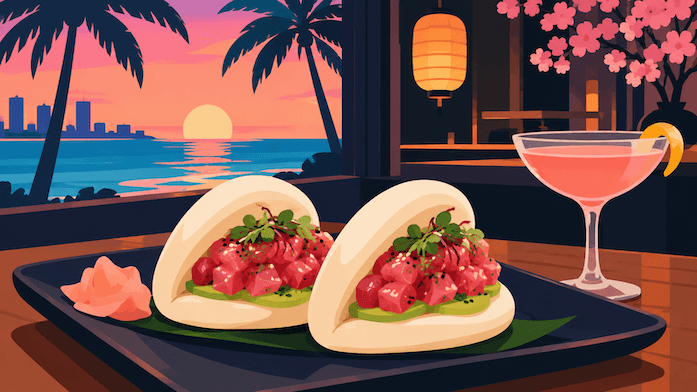
Tokyo Sushi Speakeasy’s bao small plates — the Tuna Tartare Bao and Torched Salmon Bao — are two of the most technically precise tuna tartare bao South Beach has to offer, each built around a contrast between soft steamed dough and high-impact Japanese-inspired fillings. The Tuna Tartare Bao layers fresh tuna tartare, avocado-edamame guacamole, and crispy shallots finished with sesame — verify current pricing and exact ingredients directly with the venue before visiting, as menus change; the Torched Salmon Bao delivers torched salmon, spicy mayo, and togarashi spice with a heat that escalates exactly as designed.
Key Takeaways
The Tuna Tartare Bao combines fresh tuna tartare with avocado-edamame guacamole and crispy shallots — a dish built on textural contrast rather than richness alone.
The Torched Salmon Bao uses togarashi spice to create a heat progression that intensifies with each bite, distinguishing it from standard spicy mayo applications.
Both bao plates are served as two pieces and function as designed share plates at Tokyo Sushi Speakeasy in South Beach — check the current menu directly for up-to-date pricing, as restaurant prices change frequently.
Bao as a format works for sushi-adjacent venues because the soft dough absorbs marinades without overwhelming the fish, preserving the integrity of Japanese-forward flavors.
Pairing these starters with a cocktail — particularly something citrus-led or floral — amplifies the seasoning contrast between cold raw fish and warm torched protein.
Tokyo Sushi Speakeasy is located at 1000 Collins Ave, Miami Beach, FL 33139 — confirm current hours of operation directly with the venue before visiting, as days and times are subject to change.
What Makes Bao Work as a Japanese-Inspired Small Plate?
Bao — the steamed, pillowy bun most closely associated with Chinese culinary tradition, though regional variants exist across East and Southeast Asia — has become one of the most effective vehicles for modern Japanese-inflected cooking precisely because it refuses to compete with the filling. The dough is intentionally neutral: soft, lightly sweet, and porous enough to absorb sauces without becoming soggy within the window of service. That structural passivity is exactly what a strong tartare or a torched piece of fish needs around it.
In practice, the bao format creates three distinct textural layers in a single bite: the yielding softness of the steamed bun, the varied texture of the filling, and whatever crunchy element is added to interrupt the uniformity. At Tokyo Sushi Speakeasy, that final layer is crispy shallots on the Tuna Tartare Bao and the slightly charred edge of the torched salmon on the other. Neither is accidental.
The format also solves a real problem for late-night share plates: portioning. Two-piece bao servings let a table of four share multiple starters without over-ordering. They eat clean, they plate dramatically, and they land fast — all of which matters when the room is running at South Beach pace after 9PM.
Tuna Tartare Bao South Beach: Breaking Down Every Component
The Tuna Tartare Base
Fresh tuna tartare at this level means hand-cut, not machine-processed fish. The distinction matters because machine-cut tartare is generally understood to lose structural integrity — and culinary professionals often note that increased cell damage can affect both color and flavor in the marinade, though the precise mechanics vary by fish and preparation. Hand-cut tuna holds its form in the bao, giving each bite visible, distinct pieces of fish rather than a paste.
The tartare at Tokyo Sushi Speakeasy follows the principle that seasoning should illuminate the fish, not mask it. That means restrained use of acid and oil — enough to round out the flavor and add gloss, not enough to turn the tuna into something unrecognizable. The result is a tartare that reads as tuna first, seasoning second.
Avocado-Edamame Guacamole
This is the component that separates the Tuna Tartare Bao from a conventional tartare preparation. Standard avocado cream or sliced avocado would add fat and creaminess — both useful in counterbalancing the lean, mineral quality of raw tuna — but the edamame introduces a different dimension entirely.
Edamame carries a mild, grassy sweetness and a firmer texture than avocado. When blended or roughly mashed together, the two create a guacamole-style base that is simultaneously creamier than edamame alone and more textured than plain avocado. The result sits beneath the tuna and acts as a moisture barrier between the filling and the bun, preventing the dough from becoming saturated while adding a layer of flavor that bridges Japanese and broader Pacific Rim influences.
From a flavor-profile standpoint, the edamame also softens any sharpness in the seasoning — a useful moderating element when crispy shallots are about to add a punch of savory, caramelized intensity on top.
Crispy Shallots and Sesame Finish
Crispy shallots are one of the most underused finishing elements in modern Japanese cooking. They provide the same allium depth as fried garlic or scallion but with a slightly sweeter, less aggressive profile that doesn’t overpower the fish beneath.
The sesame finish — whether white sesame seeds, toasted black sesame, or sesame oil applied as a final touch — adds a nutty aromatic that ties the entire plate together. Sesame is widely regarded as one of the prominent aromatic elements in Japanese cooking; its presence here signals that the bao is reading from a Japanese framework rather than a pan-Asian one.
Together, crispy shallots and sesame create a top layer that delivers crunch, fragrance, and umami depth in the first moment of the bite — before the tartare and guacamole take over in the middle register.
Torched Salmon Bao: Understanding the Heat Architecture
Why Torching Changes Everything
Torching salmon does three things cold preparation cannot. First, it renders surface fat into a thin, caramelized edge — crisp on the outside, soft within. Second, it creates Maillard compounds, the same ones that make seared meat taste savory and deep. Third, it builds a temperature gradient: warm and charred on the outside, near-raw in the center. Each bite covers two temperature zones at once.
This is not a stylistic flourish. Torching is a specific technique deployed in Aburi-style sushi preparation, a method developed in Japan and popularized internationally in the early 2000s. According to Serious Eats, Aburi-style salmon — flame-kissed to render fat without cooking through — produces a distinctly richer, more buttery flavor than raw salmon because the heat activates the fat content near the surface. The Torched Salmon Bao at Tokyo Sushi Speakeasy applies this same principle to a format that makes the technique immediately accessible to a broader table.
Spicy Mayo and Togarashi: A Calibrated Heat System
Spicy mayo appears on sushi menus across every price point, which means its quality varies enormously. At its worst, it is simply Sriracha mixed into kewpie mayo with no further thought. At its best — and at Tokyo Sushi Speakeasy this lands closer to the latter — it is a balanced emulsion where the heat is tempered by fat, the fat is balanced by a faint sweetness, and the whole thing sits under the palate rather than charging at it.
Togarashi is where the Torched Salmon Bao differentiates itself. Shichimi togarashi — the seven-spice blend used across Japanese cuisine — typically contains red chili, sansho pepper, orange peel, black and white sesame, ginger, and nori. The result is not simply heat; it is heat layered with citrus brightness, floral pepper notes from the sansho, and a faint seaweed depth from the nori. That complexity is what the menu description means when it states “the heat builds exactly as much as it should.”
The heat architecture works in two phases. The spicy mayo delivers immediate warmth that peaks in the middle of the bite. The togarashi’s sansho pepper and chili dust create a secondary heat that arrives slightly later and lingers longer — a finish rather than a strike. For guests who are heat-sensitive, this is not a dish to dismiss outright; it is worth understanding before ordering that the heat is progressive and cumulative across the two-piece serving, not a single sharp moment.
How to Order These Bao Plates at Tokyo Sushi Speakeasy
Build the Right Sequence
Small plates at Tokyo Sushi Speakeasy are designed to arrive before or alongside the sushi courses, not after. Ordering the Tuna Tartare Bao and Torched Salmon Bao as the first plates on the table sets a textural and flavor baseline that makes subsequent nigiri and signature rolls land with more context.
The small plates and starters cover a broader range of the menu’s opening courses — worth reading before your visit if you’re planning a full table progression.
For a first visit, a practical sequence runs: bao plates first, then one or two sashimi or nigiri selections, then a signature roll to close. This gives the table a graduated experience from small and high-impact to refined and precise.
Pairing the Bao Plates with Cocktails
The Tuna Tartare Bao pairs best with something clean and citrus-forward — the Lychee Martini at Tokyo Sushi Speakeasy (vodka, lychee sake, lychee juice, fresh lime) works well because the lime acid mirrors the tartare’s seasoning without adding more richness.
The Torched Salmon Bao requires more thought. Pairing it with another spicy or heavy pour risks compounding the heat. A floral or slightly sweet cocktail — something with elderflower, yuzu, or fresh citrus notes — provides contrast that allows the togarashi’s complexity to register clearly rather than getting buried under competing intensity.
The broader guide to the best cocktails to pair with sushi covers paring logic in more detail, including how to match drink weight to fish preparation.
Sharing vs. Individual Ordering
Two-piece bao servings are designed to be shared between two people as a single bite each, or eaten individually as a full starter serving. For a table of four, ordering both bao plates creates a four-bite shared experience that covers two distinct flavor profiles without requiring duplication.
If only one bao is being ordered, the Torched Salmon Bao has broader cross-table appeal given the accessibility of its flavors. The Tuna Tartare Bao rewards guests who appreciate raw fish as a primary flavor experience — it does not obscure the tuna.
Why Small Plates Define the South Beach Dining Moment
South Beach dining culture since 2020 has moved decisively toward share-plate formats — driven partly by the nightlife integration that venues like Tokyo Sushi Speakeasy are built around, and partly by a broader shift in how groups eat after dark. According to the National Restaurant Association, share plates and small-format starters now represent one of the fastest-growing menu categories across upscale casual dining in the United States, with 2025 data indicating significant growth in table-share ordering at dinner service.
The bao format fits this moment precisely. It is visually distinct, arrives plated for impact, and disappears in two bites — leaving room for the next plate without filling the table prematurely. At a venue like Tokyo Sushi Speakeasy, where the experience is as much about the room and the rhythm of the evening as the food itself, that pacing control matters.
For anyone exploring the full scope of what distinguishes a Japanese speakeasy dining format from a conventional sushi restaurant, the Edomae technique guide provides useful context for how Japanese culinary principles inform even the non-traditional elements of the menu.
Frequently Asked Questions
What is in the Tuna Tartare Bao at Tokyo Sushi Speakeasy?
The Tuna Tartare Bao contains fresh tuna tartare, avocado-edamame guacamole, and crispy shallots, finished with sesame. It is served as two pieces and priced at $18. The avocado-edamame guacamole is the distinctive element that separates this bao from conventional tartare preparations at other venues.
How spicy is the Torched Salmon Bao?
The Torched Salmon Bao is moderately spicy with a progressive heat build. The spicy mayo delivers initial warmth, while the togarashi spice blend — which includes chili, sansho pepper, and citrus peel — creates a secondary, cumulative heat that intensifies across the two-piece serving. Guests who are sensitive to heat should note this before ordering.
Are the bao plates at Tokyo Sushi Speakeasy gluten-free?
Steamed bao buns are made from wheat flour and are not gluten-free. Guests with gluten sensitivities or celiac disease should inform the team when reserving or ordering. Tokyo Sushi Speakeasy can be reached at (786) 728-9318 to discuss dietary requirements ahead of a visit, or review the full menu at the Tokyo Sushi Speakeasy menu page.
What is the best way to order bao plates alongside sushi at Tokyo Sushi Speakeasy?
Order bao plates as the first course, before nigiri or signature rolls arrive. This allows the stronger, more textured flavors of the bao to open the palate without competing with the precision of clean-cut fish preparations. A practical sequence for a first visit is covered in the first-timer’s ordering guide.
What is togarashi and why is it used on the Torched Salmon Bao?
Togarashi — specifically shichimi togarashi — is a Japanese seven-spice blend containing red chili, sansho pepper, orange peel, sesame, ginger, and nori. It is used on the Torched Salmon Bao because its layered spice profile creates a more complex heat than a single chili would. The sansho pepper contributes a floral, slightly numbing quality; the orange peel adds brightness; and the nori grounds the blend with umami depth.
Can the bao plates be ordered for a larger group at Tokyo Sushi Speakeasy?
Yes. Both bao plates can be ordered in multiples to accommodate larger tables. For groups planning a full evening — birthday dinners, celebrations, or group nights out — Tokyo Sushi Speakeasy’s team can help structure a menu that incorporates multiple small plates alongside sushi courses.