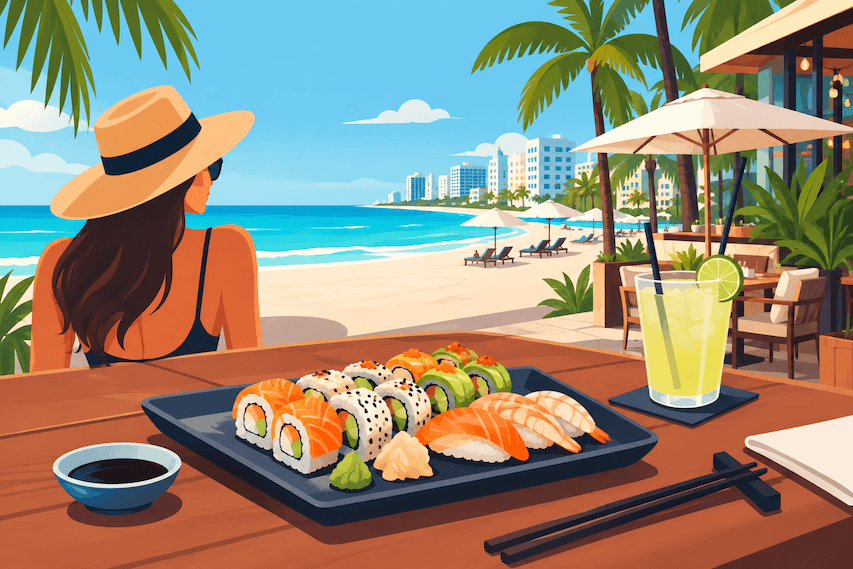
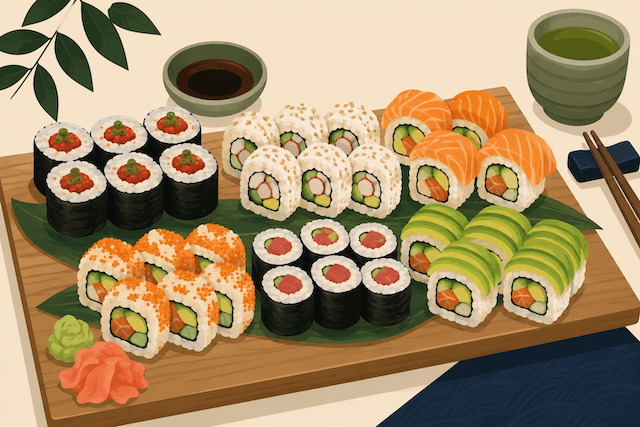
Classic sushi rolls have defined American sushi menus for decades. The spicy tuna, California, Alaska, and Dancing Eel are the most recognized examples. Each one pairs a core protein with a handful of ingredients. The result depends on technique and quality — not complexity.
Key Takeaways
Classic sushi rolls like the California, Alaska, Spicy Tuna, and Dancing Eel are among the most ordered rolls in American Japanese restaurants, and their staying power comes from balance, not simplicity.
Ingredient quality is the single greatest variable separating an average classic roll from an exceptional one — the same recipe produces entirely different results depending on the fish and rice.
At Tokyo Sushi Speakeasy, classic rolls are executed with Edomae-influenced precision: eight pieces per order, priced from $18 to $20, built to the same standard as the signature menu.
The California Roll is widely credited with making sushi approachable to American diners and is generally considered one of the most recognized sushi items in the United States and beyond.
Spicy tuna filling is a technical test — the ratio of sriracha, mayo, and fish determines whether the heat supports the tuna or overwhelms it.
Knowing what distinguishes each classic roll helps you order intentionally and build a table that covers texture, temperature, and flavor range.
What Makes Classic Sushi Rolls Worth Ordering?
A classic sushi roll is defined not by age alone, but by its structural logic — a small number of ingredients chosen for contrast and coherence, repeated reliably across kitchens because the combination works.
Classic rolls differ from signature or specialty rolls in a fundamental way: they carry no chef ego. Where a signature roll might stack six toppings and finish with a sauce drizzle, a classic roll depends entirely on ratio and execution. The California Roll with crab, cucumber, and avocado has three ingredients. The Alaska Roll adds cream cheese to salmon and avocado. Neither roll hides behind complexity.
That restraint is precisely what makes classic rolls a useful test of kitchen standards. A Spicy Tuna Roll with fibrous, discolored tuna cannot be rescued by better rice. A California Roll with waterlogged cucumber collapses regardless of the masago finish. In practice, kitchens that execute classic rolls well tend to execute everything else well.
The History Behind America’s Most Iconic Rolls
How the California Roll changed sushi in the United States
The California Roll is one of the most consequential items in American food history. Its origins are debated, but one widely cited account — referenced by sources including Smithsonian Magazine — attributes the roll to Japanese chef Ichiro Mashita, working in Los Angeles, who is said to have substituted avocado for toro — a fatty tuna that was difficult to source consistently — and moved the nori inside, reportedly to make the roll more approachable for American diners unfamiliar with seaweed. Other chefs have also been credited with similar innovations around the same period.
The result was an inside-out roll (uramaki) with crab, avocado, and cucumber that removed every common barrier to sushi adoption: the visible seaweed, the raw fish, and the unfamiliar fatty texture. Sushi consumption in the United States is generally understood to have grown dramatically through the 1980s and 1990s, with the California Roll widely credited as a key factor — offering first-time diners a familiar, accessible entry point into Japanese cuisine.
That single decision — hiding the nori, replacing toro with avocado — restructured how an entire country approached Japanese food.
How spicy tuna became a staple
The Spicy Tuna Roll is commonly said to have emerged on the West Coast as a practical solution to fish trim — though its precise origins and timing are not definitively documented. The widely repeated account holds that rather than discard the less visually pristine cuts of tuna left from nigiri preparation, kitchens began mincing them with chili paste and building rolls that turned a cost control decision into one of the most popular items on any sushi menu.
By most accounts, spicy tuna had spread across the country over the following decade or two and become a near-universal presence on sushi menus at every price point — though the exact timeline of that spread is not formally documented. The difference between versions is almost entirely about the fish quality and the spice balance — which is why the same roll name can describe something mediocre at a supermarket and something genuinely good at a kitchen that sources properly.
The Four Classic Rolls at Tokyo Sushi Speakeasy
Tokyo Sushi Speakeasy offers four classic rolls on its menu, each priced at $18 to $20 and served as eight pieces per order. The approach is deliberate: these are not menu fillers. They are executed to the same standard as the signature rolls.
Spicy Tuna Roll — $18
Tuna and avocado inside, topped with spicy tuna, crispy shallots, and sriracha.
The Spicy Tuna at Tokyo Sushi Speakeasy is a two-layer construction. The interior pairs tuna with avocado for a clean fat-and-protein base. The topping layer adds spicy tuna mixed with sriracha and finishes with crispy shallots for texture contrast and an aromatic bite that breaks up the heat.
What separates this from a generic spicy tuna is the shallot. Most versions of this roll stop at spicy tuna and sriracha, which produces heat but little dimension. The crispy shallot adds a savory, slightly sweet crunch that gives each piece a complete flavor arc — heat at the front, richness in the middle, crunch at the finish.
The critical technical point with spicy tuna topping is temperature. It must be applied cold and served immediately. Warm spicy tuna over a freshly made roll produces a texture problem that no amount of good fish can correct.
Alaska Roll — $20
Salmon, avocado, and cream cheese inside, topped with sesame seeds.
The Alaska Roll sits in a distinct category among classic rolls because it uses cream cheese — an ingredient that divides opinion sharply among sushi purists but has been part of American roll construction for decades. In practice, it functions as a binder and a fat source that softens the salmon without overpowering it.
The version at Tokyo Sushi Speakeasy keeps the ratio controlled. Cream cheese in excess makes a roll dense and one-dimensional. At the right proportion, it provides a mild dairy contrast that actually makes the salmon taste cleaner by comparison.
Sesame seed topping on an Alaska Roll is a texture and aroma decision, not a flavor statement. Toasted sesame seeds add a faint nuttiness that complements the fat in the avocado and cream cheese without competing with the salmon.
This roll reads as approachable, and it is — but it is approachable by design, not by accident.
California Roll — $20
Crab, cucumber, and avocado inside, topped with masago and sesame seeds.
The California Roll at Tokyo Sushi Speakeasy follows the foundational structure — uramaki construction, clean three-ingredient interior — and finishes with masago (capelin roe) and sesame seeds rather than stopping at the roll surface.
Masago on a California Roll serves two functions. Visually, the orange roe creates definition across each piece that makes the roll look considered rather than assembled. In the mouth, masago adds a fine-grained, slightly briny pop that punctuates the mild sweetness of the crab and avocado.
The cucumber must be cut precisely. In practice, cucumber that is too thick makes the roll difficult to compress properly and creates an uneven bite. Cut too thin, it disappears. The right cut produces audible crunch without dominating the texture.
The California Roll is the right starting point for anyone ordering across a table of mixed sushi experience. It is universally readable, visually clean, and demonstrates rice quality more clearly than any other roll because the other flavors are restrained enough not to mask it.
Dancing Eel Roll — $20
Salmon, avocado, and cucumber inside, topped with grilled eel and masago.
The Dancing Eel is the most technically layered of the four classic rolls. Salmon, avocado, and cucumber form the base — a combination that delivers clean fat, neutral crunch, and fresh flavor — but the grilled eel topping changes the character of the roll entirely.
Unagi (freshwater eel) is served grilled and lacquered with a sweet soy-based tare sauce. Applied as a topping to a salmon roll, it introduces warmth, sweetness, and char that the interior cannot produce on its own. The result is a roll that tastes warm even though most of the ingredients are cold — a contrast that consistently surprises first-time orderers.
Masago on the Dancing Eel provides the same briny accent it does on the California, but here it also cuts through the sweetness of the eel glaze. Without it, the roll tips toward dessert-like richness. With it, the balance holds.
The name comes from the way thinly sliced eel pieces curl and shift slightly over the curved surface of the roll — a visual quality that becomes apparent when the roll is cut and plated.
How Classic Rolls Compare: A Quick Reference
RollInsideToppingFlavor ProfilePriceSpicy TunaTuna, avocadoSpicy tuna, crispy shallots, srirachaBold, heat-forward, textured$18AlaskaSalmon, avocado, cream cheeseSesame seedsRich, mild, creamy$20CaliforniaCrab, cucumber, avocadoMasago, sesame seedsClean, mild, slightly briny$20Dancing EelSalmon, avocado, cucumberGrilled eel, masagoSweet, warm, savory contrast$20
How to Build a Table Around Classic Rolls
Which classic rolls to order together
Classic rolls are designed for sharing, and the best table orders cover three axes: heat level, richness, and texture.
A well-built classic roll selection at Tokyo Sushi Speakeasy might look like this:
Start with the California Roll as a palate-neutral opener — it reads cleanly and establishes a rice quality baseline.
Add the Dancing Eel for warmth and contrast — the eel topping shifts the table’s flavor profile without repeating anything from the California.
Bring in the Spicy Tuna for heat and textural energy — the crispy shallots and sriracha punch through if the table has settled into milder territory.
Order the Alaska if the group includes diners who prefer richer, creamier profiles or are newer to sushi — it lands confidently with any palate.
This sequence covers mild, warm-sweet, heat-forward, and rich without redundancy.
Pairing classic rolls with cocktails and sake
According to our guide to the best cocktails to pair with sushi, citrus-led pours and lighter cocktails tend to work best alongside rolls with clean or briny profiles — California and Dancing Eel pair naturally with the Lychee Martini on the Tokyo Sushi Speakeasy cocktail menu.
Spicy Tuna works with drinks that have some sweetness to offset the sriracha — a floral or fruit-forward cocktail prevents the heat from accumulating across multiple pieces.
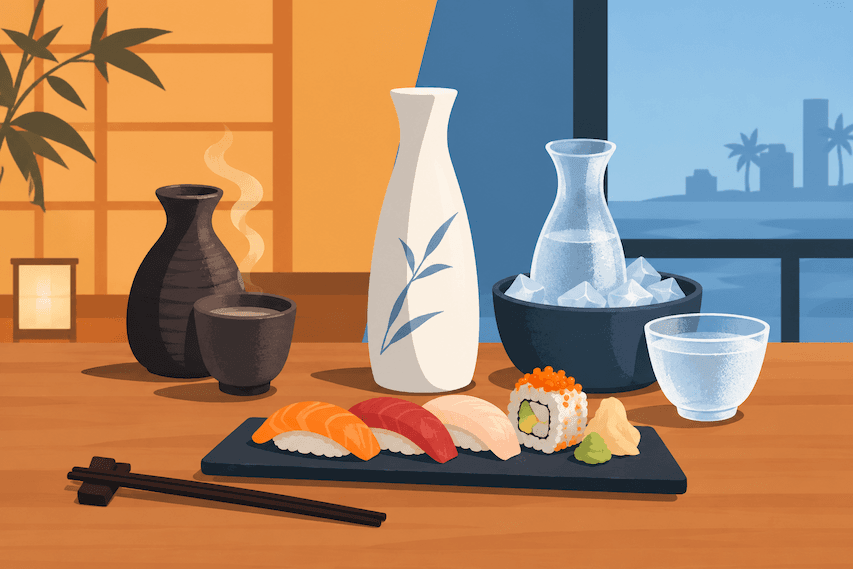
For sake pairing, our beginners guide to sake covers how junmai and ginjo styles interact with fish-forward rolls — lighter, drier styles complement salmon and tuna rolls without flattening the flavor.
What Separates a Good Classic Roll from a Great One
The margin between a competent classic roll and an excellent one comes down to three variables: rice temperature, fish sourcing, and cut precision.
Sushi rice served too cold turns dense and loses its seasoning. Served too warm, it breaks down under the weight of toppings. In practice, correct sushi rice temperature is one of the most difficult standards to maintain during a busy service — and one of the most noticeable when it fails.
Fish sourcing determines the baseline. For a Spicy Tuna Roll, the tuna used for topping is often minced from trim pieces — which is entirely correct practice — but the quality of that trim still reflects the quality of the original fish. Poor-quality tuna produces spicy tuna topping that tastes muddy regardless of the spice blend.
Cut precision affects the final presentation and eating experience. Eight pieces from a standard roll means each cut must be clean and even. A dull knife drags nori and compresses filling. Sharp, single-stroke cuts keep the structural integrity of each piece and produce the clean cross-section that makes a properly made roll identifiable immediately.
For a deeper look at how to evaluate quality before you order, the guide to identifying sushi-grade fish covers what to look for in color, texture, and smell.
Frequently Asked Questions
What is the difference between a classic sushi roll and a signature roll?
A classic sushi roll uses a small, established set of ingredients — typically two to four — and relies on technique and ingredient quality for its impact. A signature roll, like Tokyo Sushi Speakeasy’s Tokyo Gold Roll or Wagyu Truffle Roll, layers multiple toppings and finishing elements to create a more complex presentation. Both require the same precision, but classic rolls leave less room to compensate for execution errors.
Is the California Roll made with real crab?
This depends on the restaurant. Many California Rolls in the United States use imitation crab (surimi), which is processed fish paste shaped and flavored to resemble crab. Higher-quality versions use real crab meat. The ingredient list on any reputable menu will specify which is used — if it simply says “crab,” it is worth asking.
Why does spicy tuna taste so different at different restaurants?
The variation in spicy tuna comes from three factors: the quality and cut of the tuna used, the ratio of chili paste or sriracha to other binders like mayo or sesame oil, and whether the mix is applied fresh or made in advance. Pre-mixed spicy tuna that sits for hours before service loses texture and develops an off flavor that no amount of additional sriracha can mask.
What does “masago” add to a sushi roll?
Masago is capelin roe — small, fine-grained orange fish eggs used as a topping on rolls like the California and Dancing Eel. It adds a light briny flavor, a visual pop of color, and a subtle textural layer across the surface of each piece. It is milder and smaller than tobiko (flying fish roe) and should not be confused with ikura, which is salmon roe and significantly larger.
Can I order classic rolls and signature rolls at the same table?
Ordering both is common and works well. The recommended approach is to start with lighter classics — California, Alaska — before moving to bolder signature rolls like the Wagyu Truffle or Tokyo Gold. Eating in intensity order preserves your palate’s ability to register the nuances in each roll rather than arriving at the classics after your taste buds have been saturated by rich toppings.
How do classic rolls fit into a first visit to Tokyo Sushi Speakeasy?
For first-time visitors, the classic rolls provide a reliable foundation that shows the kitchen’s baseline standards before exploring the full menu. The first-timer’s guide to ordering recommends starting with two to three items — a classic roll, a nigiri selection, and one starter — to understand the menu’s range before committing to a full order.
Classic rolls earn their place on any serious sushi menu because they are impossible to fake. The California, Alaska, Spicy Tuna, and Dancing Eel at Tokyo Sushi Speakeasy are built to the same standard as the signature menu — same sourcing, same rice, same cut precision, different complexity.
If you are planning your first visit, reserve a table at Tokyo Sushi Speakeasy and use the classic rolls as your anchor. Build outward from there.