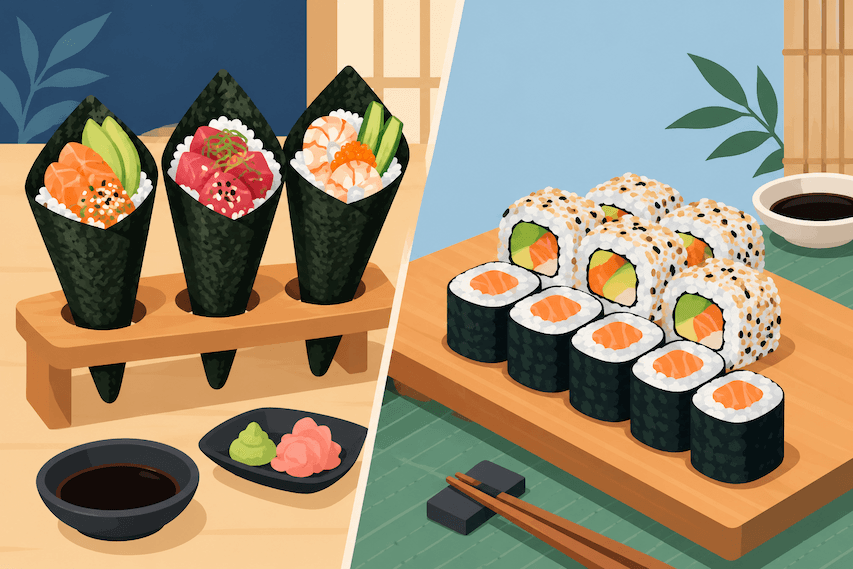
Hand rolls and sushi rolls use many of the same ingredients, but they offer different dining experiences. A hand roll, also called temaki, is a cone-shaped piece of nori filled with sushi rice, seafood, and vegetables, while a traditional cut sushi roll is rolled into a cylinder and sliced into bite-sized pieces. The biggest differences are their shape, seaweed texture, serving style, and how quickly they should be eaten.
If you’re deciding between hand rolls and sushi rolls for your next Japanese dinner, understanding these differences can help you order something that matches your appetite, flavor preferences, and dining style.
What Is the Difference Between Hand Rolls and Sushi Rolls?
The main difference is that hand rolls are individual cones designed to be eaten by hand, while cut sushi rolls are cylindrical rolls sliced into smaller pieces. Both can contain rice, seafood, vegetables, and nori, but their shapes affect their texture and how you enjoy each bite.
Here’s a quick comparison:
Feature | Hand Rolls (Temaki) | Cut Sushi Rolls (Maki) |
|---|---|---|
Shape | Cone or open-ended cylinder | Round or oval slices |
Seaweed | Wrapped around the filling | Usually wrapped around the rice and filling, or placed on the outside of an inside-out roll |
Serving style | Usually one hand roll per order | Commonly served as several pieces |
Eating method | Held and eaten with your hands | Usually eaten with chopsticks or fingers |
Texture | Crisp nori when freshly prepared | Varies depending on the roll and preparation |
Ingredients | Often a focused combination of fillings | Can contain multiple layered ingredients |
Best for | Individual portions and immediate eating | Sharing, variety, and group dining |
Neither style is inherently better than the other. Hand rolls emphasize a fresh contrast between crisp seaweed and soft filling, while cut sushi rolls offer a convenient way to enjoy several combinations in one order.
What Is a Hand Roll in Japanese Cuisine?
A hand roll, known as temaki, is a cone-shaped sushi preparation made by wrapping nori around vinegared rice and selected fillings. Its open top makes the ingredients visible, and its shape allows diners to hold and eat it without cutting it into separate pieces.
How Is a Hand Roll Made?
A hand roll is typically assembled by placing sushi rice and fillings onto a sheet or portion of nori before folding it into a cone. The ingredients are arranged to create a balanced bite, with the seaweed providing structure and a distinctive roasted flavor.
A typical hand roll may contain:
Sushi rice: Seasoned short-grain rice that provides a slightly tangy, cohesive base.
Seafood: Tuna, salmon, yellowtail, shrimp, or another selected protein.
Vegetables: Cucumber, avocado, or scallions for freshness and texture.
Sauces and seasonings: Spicy mayonnaise, ponzu, or other complementary additions, depending on the recipe.
Nori: Dried seaweed that holds the ingredients together and adds a crisp, savory element when freshly prepared.
The exact ingredients depend on the restaurant and the specific hand roll. Some feature raw seafood, while others use cooked shrimp or seared beef.
Why Should You Eat a Hand Roll Immediately?
Hand rolls are best eaten soon after preparation because moisture from the rice and fillings gradually softens the nori. Eating one promptly preserves the contrast between crisp seaweed, tender rice, and the other ingredients.
This is especially important when a hand roll contains warm or moist fillings, sauces, or avocado. The longer it sits, the less crisp the outer layer may become.
At Tokyo Sushi Speakeasy, the hand roll menu includes Spicy Tuna, Salmon Avocado, Yellowtail Scallion, Crispy Shrimp, and Wagyu Truffle options. You can explore the current sushi menu to compare the available combinations before ordering.
What Is a Traditional Sushi Roll?
A traditional sushi roll, commonly called maki, is made by arranging rice and fillings on nori, rolling the ingredients into a compact cylinder, and cutting it into individual pieces. This format makes it easy to serve multiple portions and enjoy different ingredient combinations during one meal.
What Are the Main Types of Sushi Rolls?
Sushi rolls come in several styles, with the position of the rice and seaweed being one of the main differences.
Hosomaki: Thin sushi rolls
Hosomaki are narrow rolls that usually contain one primary filling, such as cucumber or tuna. Their simple construction makes them useful when you want to focus on a particular ingredient.
Futomaki: Thick sushi rolls
Futomaki are larger rolls containing multiple ingredients. Depending on the recipe, they may combine seafood, vegetables, and other fillings to create a range of textures and flavors.
Uramaki: Inside-out sushi rolls
Uramaki place the rice on the outside and the nori around the inner fillings. They may include sesame seeds, fish roe, sauces, or additional toppings, making them common on contemporary sushi menus.
These styles differ from hand rolls mainly in how they are assembled, presented, and portioned. For a broader introduction to Japanese sushi formats, see our guide to the different types of sushi.
Why Are Cut Sushi Rolls Popular for Sharing?
Cut sushi rolls are easy to divide among diners because each roll is served in individual pieces. This makes them convenient for couples, families, and groups who want to sample several flavors without ordering a full portion of every dish.
For example, a table might order a classic roll, a specialty roll, and a few pieces of nigiri. Everyone can sample different combinations and compare flavors throughout the meal.
At a restaurant with creative specialty rolls, the sliced format also allows the chef to distribute multiple ingredients and toppings across a single presentation.
How Does Seaweed Texture Differ Between Hand Rolls and Sushi Rolls?
Seaweed texture is one of the most noticeable differences between the two styles. Hand rolls are designed to be eaten while the nori is still crisp, whereas the seaweed in cut sushi rolls may be softer because it has been in contact with rice and fillings for longer.
Why Is Crispy Nori Important in a Hand Roll?
Crispy nori gives a hand roll its characteristic snap and helps contrast the softer ingredients inside. When freshly assembled, the seaweed can add a delicate crunch that makes each bite feel distinct.
To enjoy that texture:
Order the hand roll when you’re ready to eat it.
Avoid letting it sit on the table while you finish other dishes.
Eat from the open end toward the bottom of the cone.
Ask your server for guidance if you’re unfamiliar with the serving style.
These simple habits help preserve the texture that makes hand rolls different from other sushi formats.
Why Can Cut Sushi Rolls Have a Softer Texture?
Cut sushi rolls often have a more integrated texture because the rice, fillings, and seaweed are pressed together during rolling. Moisture can gradually transfer between the ingredients, particularly if the roll sits before serving.
That softer texture isn’t necessarily a disadvantage. It can help the ingredients feel cohesive, especially in rolls with creamy avocado, cooked seafood, or sauces.
The best texture depends on the type of roll and the diner’s preference. If you enjoy a noticeable crunch, a freshly prepared hand roll may be more appealing. If you prefer a compact bite with several ingredients, a cut roll may be the better choice.
Which Is Better: Hand Rolls or Sushi Rolls?
Neither style is universally better; the right choice depends on how you prefer to eat sushi. Hand rolls are ideal when you want an individual portion with crisp seaweed, while cut rolls work well when you want to share dishes or sample several flavor combinations.
Use this guide to decide:
Your Preference | Better Choice | Why |
|---|---|---|
Crisp seaweed | Hand roll | Best enjoyed immediately after assembly |
Easy sharing | Cut sushi roll | Served in multiple bite-sized pieces |
A focused flavor combination | Hand roll | Often built around a few complementary ingredients |
Several ingredients in each bite | Cut sushi roll | Can layer seafood, vegetables, sauces, and toppings |
A casual, hands-on experience | Hand roll | Designed to be held and eaten by hand |
Sampling several dishes with friends | Cut sushi roll | Makes it easy to order and distribute different varieties |
A convenient individual serving | Hand roll | Usually served as a single cone-shaped portion |
You can also order both styles during the same meal. Comparing them side by side is a practical way to discover which textures and ingredient combinations you enjoy most.
What Ingredients Work Best in Hand Rolls and Sushi Rolls?
Both styles can feature a wide range of ingredients, but the best combinations depend on the format. Hand rolls benefit from fillings that fit neatly into a cone, while cut sushi rolls can accommodate layered ingredients and decorative toppings.
What Are Good Hand Roll Choices for Beginners?
Beginners often find it helpful to start with familiar ingredients and gradually explore stronger flavors or less familiar seafood. A hand roll is a convenient way to try one combination without committing to a larger platter.
Consider these options:
Salmon avocado: Combines mild salmon with creamy avocado.
Spicy tuna: Pairs tuna with spicy mayonnaise and other seasonings.
Yellowtail scallion: Offers a seafood-forward flavor with the freshness of scallions.
Crispy shrimp: Provides a cooked seafood option with a crunchy texture.
Wagyu truffle: Offers a richer, beef-based alternative to seafood.
Tokyo Sushi Speakeasy lists these styles on its hand roll menu. Ingredients and availability can change, so confirm the current selection with the restaurant before visiting.
Which Sushi Rolls Are Best for Trying Multiple Flavors?
Cut sushi rolls are useful when you want to explore several ingredients in one sitting. A classic roll can provide a familiar starting point, while a specialty roll may introduce richer sauces, contrasting textures, or more elaborate toppings.
Tokyo Sushi Speakeasy’s menu features signature options such as the South Beach Roll, Tokyo Gold Roll, and Wagyu Truffle Roll. These combinations illustrate how contemporary sushi rolls can move beyond a simple rice-and-fish filling.
If you are ordering for a group, consider balancing richer specialty rolls with lighter choices. This creates more variety and keeps the meal from becoming dominated by sauces or fried ingredients.
How Should You Eat Hand Rolls and Sushi Rolls?
Hand rolls are generally eaten with your hands, while cut sushi rolls can be eaten with either your hands or chopsticks. The most important practical distinction is to eat hand rolls promptly and handle both styles gently so the ingredients stay together.
How Do You Eat a Hand Roll Properly?
The easiest way to eat a hand roll is to hold it securely, take bites from the open end, and enjoy it before the nori softens. You don’t need to disassemble the cone or use chopsticks to remove the fillings.
Follow these steps:
Hold the hand roll near its middle or lower portion.
Start at the open end where the rice and fillings are visible.
Take manageable bites without squeezing the cone too tightly.
Continue eating while the seaweed is still crisp.
Use a napkin if sauces or fillings begin to escape.
There is no need to make the experience overly formal. Hand rolls are intended to be straightforward and enjoyable.
How Do You Eat Cut Sushi Rolls?
Cut sushi rolls can be picked up with chopsticks or your fingers, depending on your comfort and the restaurant’s style of service. Take a bite that allows you to enjoy the rice, filling, and any toppings together.
A few practical tips can help:
Avoid squeezing the roll too tightly with chopsticks.
Use soy sauce sparingly so it doesn’t overpower the other ingredients.
Be careful with heavily topped rolls, which may be less stable than simpler maki.
If the pieces are large, ask your server for advice rather than trying to pull the roll apart.
For more guidance on ordering and enjoying Japanese cuisine, read our practical sushi etiquette guide.
When Should You Order Hand Rolls Instead of Sushi Rolls?
Choose hand rolls when freshness of the seaweed, individual portions, and a hands-on dining experience are your priorities. Choose cut rolls when you want to share multiple flavors, compare specialty combinations, or build a varied meal for the table.
Are Hand Rolls Better for a Quick Sushi Meal?
Hand rolls can be a good option for a focused meal or an additional course because they’re served individually and are easy to eat. However, whether they make a complete meal depends on their size, ingredients, and your appetite.
If you’re especially hungry, consider combining a hand roll with nigiri, a small plate, or another sushi selection. For a lighter meal, one or two hand rolls may be enough, depending on portion size.
Are Sushi Rolls Better for Date Nights and Group Dinners?
Cut sushi rolls are especially convenient for sharing because each order provides several pieces. Couples can try different varieties together, while groups can create a selection of classic and specialty rolls for the table.
Hand rolls can complement that experience by giving each diner an individual serving with a different texture. Ordering both formats lets you enjoy variety without choosing only one style.
For a South Beach evening, you can review the Tokyo Sushi Speakeasy dining experience to learn more about the restaurant’s atmosphere and approach to Japanese dining.
Can You Order Hand Rolls and Sushi Rolls Together?
Yes, ordering both is an easy way to compare their textures and flavors in one meal. Start with a few cut rolls for variety, then add freshly prepared hand rolls when you’re ready to enjoy their crisp nori.
A balanced order might include:
A classic roll for a familiar combination of ingredients.
A specialty roll for layered flavors and additional toppings.
A hand roll for a contrast in shape and seaweed texture.
Nigiri or a small plate if you want to round out the meal.
Adjust the quantity to your appetite and the number of people dining. If you’re unsure how much to order, ask the server for recommendations based on your group’s preferences.
The goal isn’t to order as much as possible. It’s to select a mix of dishes that gives you a satisfying range of flavors, textures, and preparations.
Frequently Asked Questions About Hand Rolls vs. Sushi Rolls
Hand rolls and cut sushi rolls share many ingredients, but they differ in presentation, texture, and serving style. These answers cover the most common questions diners have when choosing between them.
Are hand rolls and sushi rolls made with the same ingredients?
Yes, both can contain sushi rice, nori, seafood, vegetables, and sauces. The ingredients depend on the recipe, but the shape and preparation method distinguish the two styles.
Is a hand roll the same as temaki?
Yes. Temaki is the Japanese term for hand-rolled sushi, typically formed into a cone and eaten with the hands. The name describes the preparation and shape rather than a particular filling.
Are hand rolls healthier than cut sushi rolls?
Neither format is automatically healthier. Nutritional content depends on the ingredients, portion size, sauces, and preparation methods. A simple seafood-and-vegetable hand roll may contain fewer rich toppings than an elaborate specialty roll, but the specific recipe matters more than the shape.
Do you eat hand rolls with chopsticks?
Hand rolls are traditionally eaten with your hands because their cone shape is designed for holding. Chopsticks are not necessary, although you can use them to handle accompanying dishes.
Why do hand rolls need to be eaten quickly?
Nori absorbs moisture from the rice and fillings, which gradually makes it softer. Eating a hand roll soon after it is prepared helps preserve its crisp texture.
Are hand rolls bigger than sushi rolls?
Not necessarily. A hand roll is usually served as an individual cone, while cut rolls are divided into multiple pieces. Total food quantity varies according to the restaurant’s recipe and serving size.
Can vegetarians eat hand rolls?
Yes, vegetarian hand rolls can be made with ingredients such as cucumber, avocado, and other vegetables. However, not every restaurant offers a vegetarian hand roll, so check the current menu and ask about sauces or other ingredients if you have dietary restrictions.
Which should a beginner try first?
Either is a reasonable starting point. A beginner who prefers familiar flavors may enjoy a simple cut roll, while someone interested in crisp seaweed and a more hands-on experience may prefer a hand roll. Cooked shrimp and vegetable fillings are useful options if you want to avoid raw seafood.
Final Thoughts: Choose the Sushi Style You Enjoy Most
Hand rolls and cut sushi rolls offer two different ways to enjoy the same core ingredients. Hand rolls emphasize crisp nori, individual portions, and immediate enjoyment, while cut rolls make it easy to share several combinations and explore different flavors.
If you’re dining at Tokyo Sushi Speakeasy in Miami Beach, consider trying both formats to discover which preparation you prefer. Browse the current menu, choose a few combinations that appeal to you, and let your appetite guide the rest of the meal.
The best choice is the one that makes your sushi dinner more enjoyable.