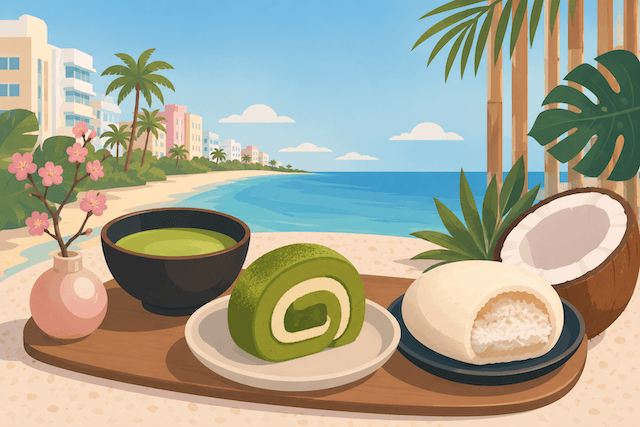
The best Japanese desserts Miami Beach has to offer are found at Tokyo Sushi Speakeasy — the Panda Coconut Bun and the Japanese Matcha Cheesecake. Both are rooted in Japanese technique. Both are worth ordering.
Key Takeaways
Tokyo Sushi Speakeasy offers two signature desserts: the Panda Coconut Bun ($15) and the Japanese Matcha Cheesecake ($15), each rooted in Japanese pastry tradition.
The Panda Coconut Bun is a warm steamed bun filled with coconut cream — a format derived from Chinese-Japanese dim sum culture that has become a fixture in modern Japanese dining.
The Japanese Matcha Cheesecake uses ceremonial-grade matcha and is finished with a mango-yuzu sauce, drawing on the Japanese jiggly cheesecake tradition distinct from its American counterpart.
Ending a multi-course sushi experience with a light, clean dessert aligns with broader Japanese dining philosophy — the final course should settle the palate, not overwhelm it.
Both desserts are available during regular service hours at Tokyo Sushi Speakeasy — confirm current days, times, and location details via the reservations page before visiting.
It is broadly observed in the hospitality industry that dessert attachment rates in fine-casual dining tend to rise when desserts are positioned as experiential rather than purely functional — which is exactly how these two items are presented.
What Makes Japanese Desserts Miami Beach Serves Different From Western Ones?
Japanese desserts are built on restraint. Where Western pastry traditions tend toward richness — dense buttercreams, heavy chocolate, high-sugar finishes — Japanese confectionery (wagashi and its modern descendants) prioritizes subtlety, texture, and the relationship between sweetness and umami.
The philosophy traces back centuries. Traditional Japanese sweets were designed to complement tea, not compete with it. That instinct carries forward into contemporary Japanese-inspired desserts: the goal is a clean finish, not a sugar overload.
In practical terms, this means Japanese cheesecakes are airier and less dense than New York-style versions. Steamed buns are soft, pillowy, and warm rather than baked and crunchy. Flavor profiles lean on ingredients like matcha, yuzu, black sesame, and coconut — all of which deliver complexity without heaviness.
At Tokyo Sushi Speakeasy, both desserts reflect this philosophy. After nigiri, sashimi, and signature rolls, the palate needs something that resolves rather than resets.
The Panda Coconut Bun: What It Is and Why It Works
The Panda Coconut Bun is a warm steamed bun — styled in the shape of a panda face — filled with lush coconut cream. It arrives at the table at $15 and functions as much as a visual moment as it does a dessert.
The Steamed Bun Tradition Behind the Dish
Steamed buns (known in Chinese dim sum culture as baozi, with Japanese variations including nikuman for savory versions and anman for sweet) have been part of East Asian food culture for many centuries, with baozi origins variously attributed by food historians to different periods of ancient Chinese history — some accounts reference as far back as the Three Kingdoms period (circa 220–280 AD), though this remains debated. The Japanese iteration is often described by culinary writers as somewhat softer and slightly sweeter in dough than many Chinese regional styles, though this is a broad generalization given the significant variation across both Chinese regional traditions and Japanese preparations.
The panda-shaped format is a modern East Asian pastry innovation — with roots in Japanese, Chinese, and Taiwanese bakery culture — that gained widespread popularity across Asia and has since moved into upscale and concept dining across the US. The format works because the visual element is immediate — it lands on the table and the table reacts.
In practice, what makes or breaks a steamed bun dessert is the filling-to-dough ratio and the temperature of the bun at the moment of service. A coconut cream filling that’s too dense becomes cloying; too thin and it disappears. The bun itself needs to be served warm enough that the dough is still slightly yielding but not so hot that the cream thins out completely.
The coconut cream filling plays a specific role here. Coconut has a natural fat content that carries sweetness without relying on added sugar to do the heavy lifting. The result is a dessert that feels indulgent but doesn’t finish heavy — which matters after a full sushi course.
Why It’s a Table Conversation Starter
The Panda Coconut Bun is described on the menu as “part dessert, part moment” — and that framing is accurate. Panda-shaped buns photograph well and arrive with an inherent personality that plain plating doesn’t. For a restaurant built around a speakeasy atmosphere with moody lighting and a room designed for lingering, a dessert that generates a table reaction is a considered choice.
For groups celebrating birthdays or date nights, it also provides a natural shared moment at the end of the meal — something to pass around, photograph, and talk about.
Japanese Matcha Cheesecake: Technique, Ingredients, and What Sets It Apart
The Japanese Matcha Cheesecake at Tokyo Sushi Speakeasy is built on a light Japanese cheesecake base, finished with ceremonial-grade matcha and a mango-yuzu sauce. At $15, it represents the more sophisticated and flavor-complex of the two dessert options.
What Is a Japanese Cheesecake?
Japanese cheesecake — sometimes called “jiggly cheesecake” or soufflé cheesecake — is fundamentally different from American-style cheesecake in structure and intent. It typically incorporates whipped egg whites (meringue) folded into a cream cheese base and is generally baked in a water bath, though specific techniques vary by recipe. The result is a cake that is lighter, softer, and far less dense than a New York-style cheesecake.
The texture is closer to a chiffon cake than a traditional cheesecake — airy enough to dissolve on the palate rather than sit heavily. For a post-sushi dessert, this structural lightness is the point.
Japanese cheesecake became widely recognized outside Japan through the success of several specialty chains and international operators — including Uncle Tetsu, which originated in Fukuoka, Japan, and expanded globally — that helped establish the style commercially. In recent years, the format has spread across the US, appearing in bakeries and restaurants in New York, Los Angeles, and Miami.
What Ceremonial-Grade Matcha Actually Means
Matcha is produced by stone-grinding shade-grown green tea leaves into a fine powder. The grading system — culinary, premium, and ceremonial — reflects the quality of the leaf, the harvest, and the grinding process.
Ceremonial-grade matcha is the highest grade, produced from the youngest leaves of the first harvest (ichiban cha). It has a naturally sweeter, less bitter flavor profile than culinary-grade matcha, a more vibrant green color, and a finer texture that disperses more evenly through a batter without creating bitter pockets.
Using ceremonial-grade matcha in a dessert application is a deliberate quality choice. Culinary-grade matcha is cheaper and more common in restaurant settings, but it carries more bitterness and a duller color. The difference is visible and tasteable — the cheesecake at Tokyo Sushi Speakeasy carries the vivid green and clean finish that only ceremonial-grade matcha produces.
According to the Tea Association of the USA, matcha consumption in the United States has grown consistently since 2016, driven by both wellness interest and culinary adoption in upscale restaurant settings.
The Mango-Yuzu Sauce: Why This Pairing Works
Yuzu is a Japanese citrus fruit — smaller than a lemon, more fragrant, with a flavor that sits somewhere between mandarin, lemon, and grapefruit. It has been used in Japanese cooking and desserts for centuries and carries a distinctive tartness that matcha responds well to.
The pairing logic is direct: matcha is earthy and slightly bitter; yuzu is bright and acidic. They balance each other in the same way that a squeeze of lemon on rich fish cuts through the fat.
Mango adds a tropical sweetness that ties the sauce to Miami’s own flavor vocabulary — a choice that reflects Tokyo Sushi Speakeasy’s position as a restaurant that respects Japanese technique while being grounded in South Beach’s energy and clientele.
The combination of mango and yuzu is also a classic found in Japanese-Hawaiian fusion cuisine and has appeared in upscale Japanese-American restaurants across the country since the mid-2010s.
How the Dessert Course Fits the Tokyo Sushi Speakeasy Ritual
Tokyo Sushi Speakeasy describes its dining experience as a ritual — a deliberate, sequenced evening rather than a transactional meal. The experience page reflects this: the room, the courses, the cocktails, and the pacing all serve a single arc.
Dessert is the final note of that arc. It needs to close the loop without undermining the courses that preceded it.
Both the Panda Coconut Bun and the Japanese Matcha Cheesecake achieve this. Neither is a heavy, cream-forward Western dessert that would leave the table feeling overfull. Both are Japanese in technique and flavor, which means they extend the evening’s culinary language rather than interrupting it — consistent with a Japanese dining sensibility in which the final course is meant to resolve the meal cleanly rather than overwhelm what came before it.
For guests who have moved through nigiri and signature rolls and are finishing with a cocktail, a light, warm bun or a slice of airy matcha cheesecake is exactly the right resolution.
This matters in a speakeasy dining context. The goal is to end the night with the same energy the evening opened with — not to land heavily and disperse quickly.
What to Drink With Japanese Desserts
Dessert pairing in a Japanese context follows different rules than the standard Western framework of dessert wines and sweet liqueurs.
Pairing the Panda Coconut Bun
Coconut cream is sweet and fatty. The ideal pairing cuts through that fat with acidity or counters it with aromatic complexity.
A yuzu-forward cocktail provides citrus contrast that lifts the coconut.
A dry, chilled sake — particularly a junmai daiginjo — offers clean minerality that cleanses the palate between bites.
Sparkling sake or a light prosecco-based cocktail also works — carbonation helps reset the palate.
Pairing the Japanese Matcha Cheesecake
Matcha desserts pair well with light, aromatic drinks that don’t compete with the matcha’s earthiness.
A lychee martini (vodka, lychee sake, lychee juice, fresh lime) is a natural match — the floral sweetness of lychee and the tartness of lime complement the matcha-yuzu combination.
Hot hojicha (roasted Japanese green tea) served alongside the cheesecake is a traditional pairing that extends the tea ceremony sensibility of the dessert.
A clean, unflavored daiginjo sake served slightly chilled works equally well for guests who want to stay in the sake program throughout the meal.
For guests who want guidance on the full sake selection at Tokyo Sushi Speakeasy, the sake flights post covers the range in detail.
Should You Order One Dessert or Both?
For a table of two: order both and split them. The Panda Coconut Bun and the Japanese Matcha Cheesecake are designed at a portion size and price point that makes sharing natural — each is $15, and the contrast between warm-bun and chilled-cheesecake creates a more complete dessert experience than either alone.
For a solo diner: the Japanese Matcha Cheesecake is the more complete standalone dessert in terms of flavor complexity. The Panda Coconut Bun rewards sharing for the table experience it creates, but eaten alone it’s still a worthy close to the meal.
For groups: order both without hesitation. The Panda Coconut Bun’s visual element lands differently at a larger table — and multiple cheesecake slices around a shared table extends the evening naturally.
If you are planning a birthday dinner at Miami Beach, both desserts on the table simultaneously creates a more memorable close to the celebration than a single option.
Frequently Asked Questions
What are the desserts at Tokyo Sushi Speakeasy?
Tokyo Sushi Speakeasy currently offers two desserts: the Panda Coconut Bun, a warm steamed bun filled with coconut cream ($15), and the Japanese Matcha Cheesecake, a light Japanese-style cheesecake made with ceremonial-grade matcha and served with mango-yuzu sauce ($15). Both are available Wednesday through Sunday during regular service hours.
What is the difference between Japanese cheesecake and regular cheesecake?
Japanese cheesecake incorporates whipped egg whites folded into a cream cheese base and is baked in a water bath, producing a significantly lighter, airier texture than American-style cheesecake. Where New York-style cheesecake is dense and rich, Japanese cheesecake dissolves on the palate and finishes clean — making it a better fit for the end of a multi-course Japanese dining experience.
What is ceremonial-grade matcha and why does it matter in desserts?
Ceremonial-grade matcha is produced from the youngest leaves of the first tea harvest, stone-ground to a fine powder. It has a sweeter, less bitter flavor profile and a more vibrant green color than culinary-grade matcha. In a dessert application, this distinction is visible and tasteable — ceremonial-grade matcha produces a cleaner, more nuanced flavor rather than the sharper bitterness associated with lower-grade powder.
What drinks pair well with Japanese desserts?
Coconut-based desserts like the Panda Coconut Bun pair well with yuzu cocktails, dry junmai daiginjo sake, or sparkling sake. Matcha cheesecake pairs naturally with lychee-forward cocktails, hojicha tea, or a clean, chilled daiginjo sake. Both desserts respond well to drinks with citrus acidity or floral aromatic profiles that complement rather than compete with the dessert’s core flavors.
Can I visit Tokyo Sushi Speakeasy just for dessert?
Tokyo Sushi Speakeasy is a full-service Japanese dining and cocktail experience rather than a dessert bar. The dessert menu is designed as a finale to the full ritual — nigiri, rolls, small plates, and cocktails — rather than a standalone destination. That said, reservations for the full experience are straightforward to arrange through the reservations page.
Are the desserts at Tokyo Sushi Speakeasy shareable?
Both desserts are designed at a portion and price point that encourages sharing. A table of two ordering both and splitting them is the recommended approach, offering contrast between the warm Panda Coconut Bun and the chilled matcha cheesecake. For larger groups, multiple orders of both items extend the dessert course naturally and add a visual element to the end of the meal.
Both desserts at Tokyo Sushi Speakeasy close the evening on the same terms it opened: with intention, Japanese craft, and a specific awareness of how a dish lands at the table. If you are planning a night at 1000 Collins Ave, reserve a table and let the full ritual run its course — the Panda Coconut Bun and the Japanese Matcha Cheesecake are not afterthoughts. They are the last note, and they hold.