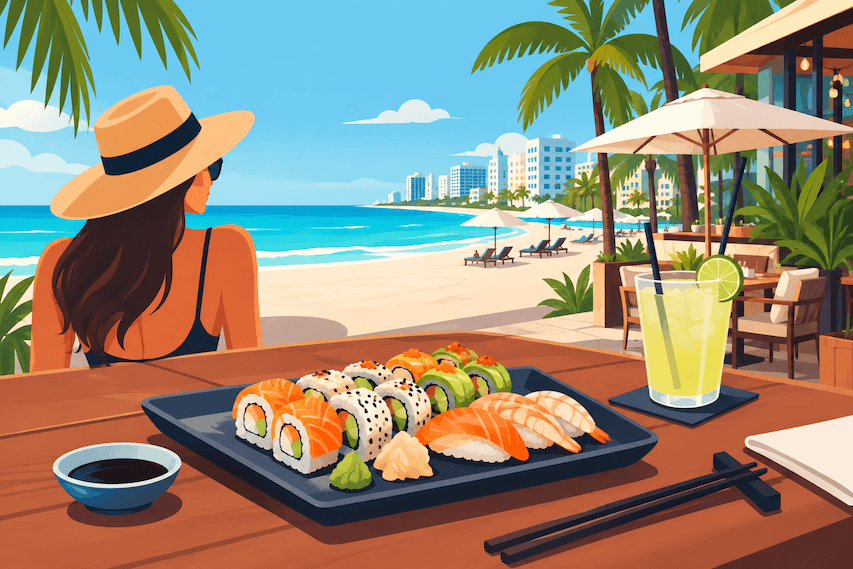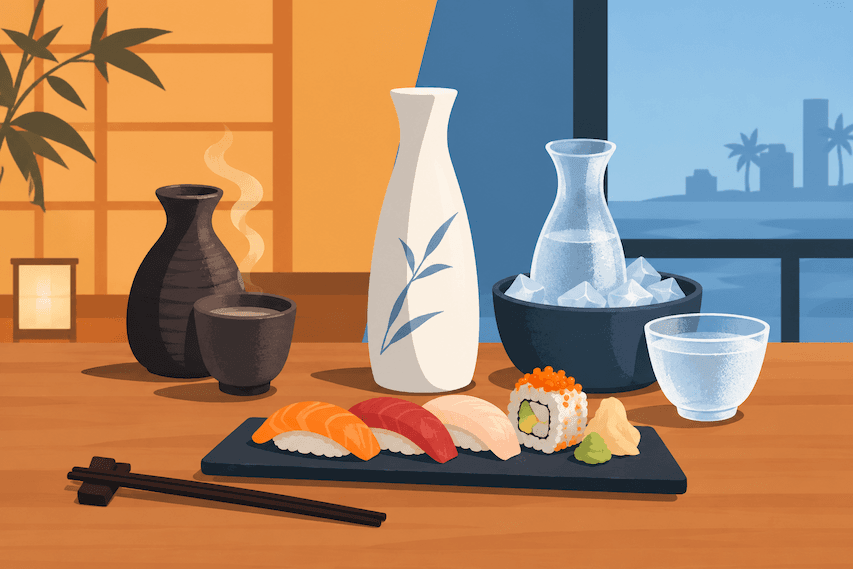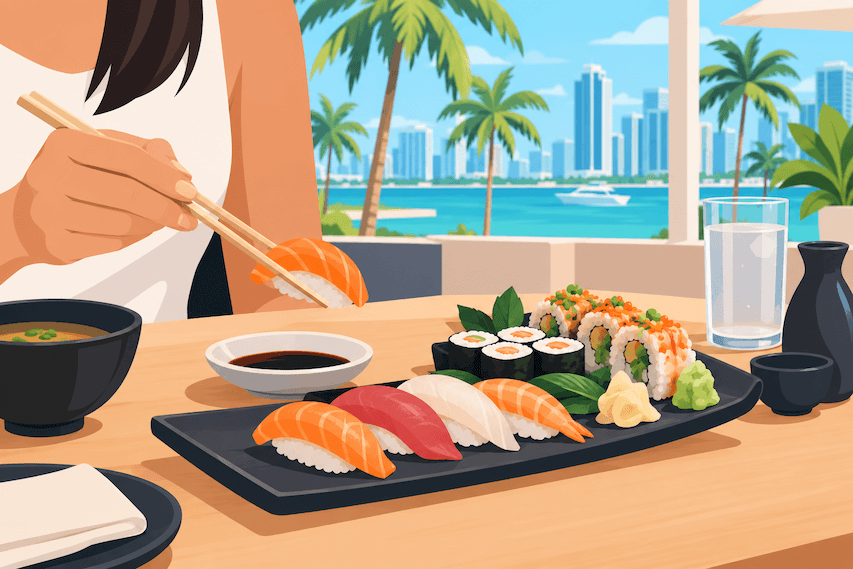
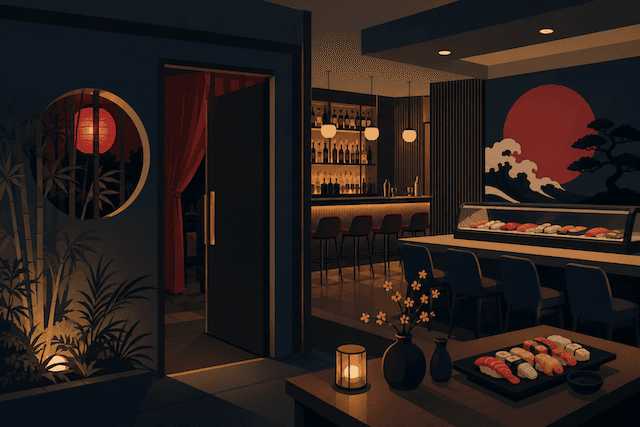
Tokyo Sushi Speakeasy sits at 1000 Collins Ave in Miami Beach. It’s a Japanese speakeasy South Beach dining experience with a difference. Edomae sushi technique meets a moody, late-night atmosphere built for South Beach’s after-dark crowd. The food is precise. The room is alive. Both work together.
Key Takeaways
Tokyo Sushi Speakeasy operates Wednesday through Sunday from 5PM to 12AM at 1000 Collins Ave, Miami Beach, FL 33139, making it one of the few late-night Japanese dining venues in South Beach. (Hours and address should be confirmed directly with the venue before your visit, as operational details are subject to change.)
The restaurant draws on Edomae technique — the traditional Tokyo-style sushi method centered on clean cuts, precise seasoning, and fish-forward restraint — applied within a contemporary speakeasy environment.
Signature offerings include the Tokyo Gold Roll topped with 24K gold leaf and the Wagyu Truffle Roll, both designed as centerpiece dishes for table sharing.
The space is intentionally designed for date nights, group celebrations, and birthday dinners, with low lighting, curated cocktails, and an atmosphere calibrated for extended evenings.
Tokyo Sushi Speakeasy has maintained a high Google rating with a strong volume of verified reviews, consistently ranking among the well-regarded Japanese restaurants in South Beach. Check the live Google listing for the current rating and review count, as these figures update frequently.
Larger groups can coordinate dedicated event planning by contacting the venue directly — confirm the current group size threshold and events contact details with Tokyo Sushi Speakeasy before reaching out, as these details are subject to change.
What Is a Japanese Speakeasy? South Beach’s New Dining Standard
A Japanese speakeasy dining experience combines the exclusivity and atmosphere of a hidden bar with the craftsmanship of a serious Japanese kitchen. The concept borrows the speakeasy’s hallmarks — intimate seating, low lighting, curated cocktails, and a sense of discovery — and anchors them around a sushi program built on traditional technique.
This is not a gimmick. The speakeasy format works particularly well with Japanese dining because both traditions share an emphasis on restraint, precision, and the idea that the experience matters as much as the product. In practice, that means the environment is engineered to slow the meal down, extend the evening, and give every dish the attention it deserves.
Industry observers have noted that experiential dining — defined as restaurants where atmosphere and presentation form a meaningful part of the offer — has been among the more sustained growth categories in food service in recent years. Tokyo Sushi Speakeasy sits squarely at the intersection of that trend and South Beach’s established appetite for late-night premium dining.
The Edomae Foundation: Why the Technique Matters
Edomae sushi is not a marketing term — it is a specific culinary tradition that originated in Edo (the former name of Tokyo) and defined what sushi was before modernization diluted the discipline.
The core principles of Edomae technique include:
Precise knife work to achieve clean, uniform cuts that preserve fish texture
Deliberate rice seasoning with carefully balanced rice vinegar, salt, and sugar
Fish-forward presentations that allow ingredient quality to carry the plate
Minimal garnish — what appears on the plate has a function, not a decorative excuse
Temperature discipline, including the precise timing of fish preparation relative to service
What actually happens when a kitchen abandons these principles is immediately visible: fish tears rather than cuts, rice compresses rather than holds, and flavor becomes muddy rather than clean. The Edomae approach forces quality because there is nowhere to hide.
At Tokyo Sushi Speakeasy, this technical baseline applies across nigiri, sashimi, and even the more theatrical signature rolls. The Tokyo Gold Roll — shrimp tempura, eel, and avocado topped with tuna, ikura, spicy mayo, eel sauce, and edible gold leaf — is visually dramatic, but the architecture underneath is precisely executed. (Confirm current ingredients and garnish details with the venue, as menu compositions are subject to change.) The gold leaf is the statement; the sushi technique is the substance.
What Makes the Atmosphere Different From a Standard Japanese Restaurant?
Most Japanese restaurants in Miami operate in one of two modes: casual lunch-format dining or formal omakase-style counters with hushed environments. Tokyo Sushi Speakeasy occupies a distinct third space.
The room runs on its own rhythm. Lighting is low and deliberate — calibrated to create intimacy without becoming oppressive. Music has presence without overwhelming conversation. Tables are spaced to allow the kind of privacy that date nights and anniversary dinners require, while the overall energy of the room keeps pace with South Beach’s nightlife tempo.
This calibration matters because atmosphere directly affects how people eat. Research in multisensory perception — including work associated with crossmodal research in experimental psychology — suggests that environmental factors such as background noise level, lighting intensity, and ambient music tempo can measurably influence flavor perception and the pace at which diners consume food. A room designed for lingering produces a fundamentally different meal than one designed for turnover.
In practice, what this means at Tokyo Sushi Speakeasy is that a table for two on a Friday night is not a 60-minute transaction. The experience is designed to extend across two to three hours, moving from pre-dinner cocktails through to share plates, signature rolls, and dessert — with each course paced by the room’s energy rather than a server’s efficiency targets.
For those planning a date night in South Beach, the date night experience at Tokyo Sushi Speakeasy specifically benefits from this pacing. The menu’s structure — from lighter nigiri and sashimi into richer signature rolls — creates a natural arc that carries a two-person dinner forward without requiring any deliberate planning from the guests.
The Menu Architecture: How Every Section Connects
Nigiri and Sashimi: The Technical Foundation
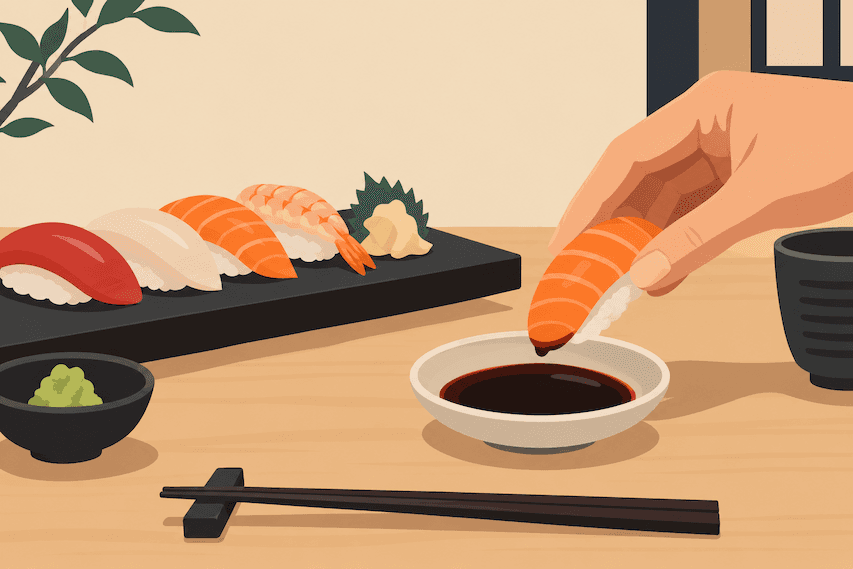
A kitchen’s nigiri and sashimi program reveals its actual capability more honestly than any signature roll. These preparations have no distraction. The quality of the fish, the precision of the cut, and the balance of the seasoning are all immediately apparent.
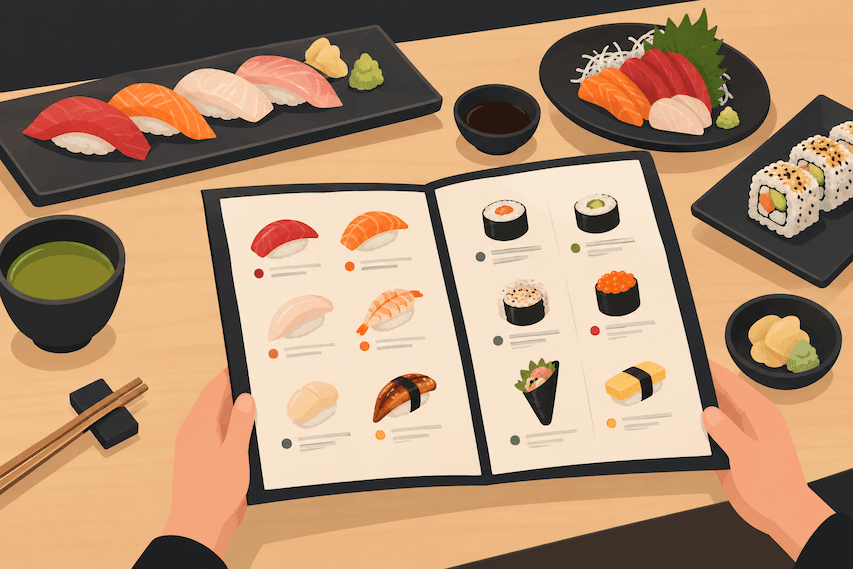
Tokyo Sushi Speakeasy’s nigiri selection starts from $10 and covers the range from clean tuna cuts to more textured options requiring knife skill and timing. The sashimi plates start from $22 and are plated with sharp visual contrast — fish against clean ceramic, garnish reduced to function.
For first-time visitors, ordering two to three pieces of nigiri before moving to rolls is the most effective way to understand the kitchen’s standard. If the rice is properly seasoned and the fish is clean and consistent, the rest of the meal will hold.
Signature Rolls: Where Craft Meets Statement
The signature roll program at Tokyo Sushi Speakeasy is where Edomae discipline meets South Beach appetite for spectacle. These are not rolls designed to replace traditional sushi — they are designed for the table-share moment that defines a late-night dining experience.
The current lineup includes:
RollKey IngredientsPriceTokyo Gold RollShrimp tempura, eel, avocado, tuna, ikura, spicy mayo, eel sauce, edible gold leaf$35Wagyu Truffle RollBeef tartare, chives, wagyu slices, truffle mayo, crispy garlic$34South Beach RollSalmon, shrimp, avocado, crispy crab, caviar$24
The Wagyu Truffle Roll is the menu’s most discussed dish among repeat visitors — the combination of beef tartare in the interior with wagyu slices on top creates layered richness that works specifically because the rice and cut underneath are clean enough not to compete.
The South Beach Roll’s rise to guest favorite status reflects a different appetite: salmon, shrimp, and avocado inside, with crispy crab and caviar on top is approachable enough for any sushi experience level while still delivering the kind of textural contrast that defines the restaurant’s culinary point of view.
Cocktails: Designed for the Room, Not the Bar
The cocktail program at Tokyo Sushi Speakeasy is not an afterthought appended to a sushi menu. The drinks are engineered to work alongside the food — citrus-led pours that cut through fat, floral elements that complement delicate fish, and smoky notes that pair with richer preparations.
The Lychee Martini — vodka, lychee sake, lychee juice, and fresh lime in a chilled martini glass at $18 — is consistently one of the most ordered drinks in the room. Its sweetness is controlled by the lime’s acidity, and the lychee sake bridge between the vodka base and the sushi program makes it genuinely functional as a food pairing rather than a standalone drink.
For a structured guide to matching drinks with specific dishes, the cocktail and sushi pairing guide covers the principles in detail, including which flavor profiles amplify raw fish and which conflict with it.
Who Books Tokyo Sushi Speakeasy — and Why
Date Nights and Anniversary Dinners
South Beach has no shortage of restaurants. The question for a date night or anniversary dinner is not whether good food exists — it is whether the environment supports the kind of evening being planned.
Tokyo Sushi Speakeasy’s lighting, pacing, and menu structure are explicitly designed for two-person extended dining. The room rewards people who want to stay, not diners cycling through on a 45-minute window. Reservations on Wednesday and Thursday evenings tend to offer a more intimate experience, while Friday and Saturday carry more of the full South Beach nightlife energy.
Birthday Celebrations and Group Dinners
Celebratory dining at Tokyo Sushi Speakeasy scales differently from a standard restaurant. The menu’s share-plate format — signature rolls cut into eight pieces, sashimi platters, chef specials — is inherently suited to group tables where ordering individually defeats the point.
For anyone planning a birthday dinner in Miami Beach, the combination of dramatic plating, bottle-service-adjacent cocktail options, and the room’s existing energy removes the pressure of manufacturing a celebration atmosphere. It is already there.
Larger groups should contact the venue directly to coordinate ahead of time — walk-in groups cannot be accommodated reliably. Confirm the current events contact and any group size minimums with Tokyo Sushi Speakeasy before reaching out.
Late-Night Dining After South Beach Events
The Wednesday-through-Sunday midnight closing time positions Tokyo Sushi Speakeasy as one of the few quality Japanese dining options available after 10PM in the area. For visitors who have spent early evening hours on Ocean Drive or Lincoln Road, the restaurant functions as a natural continuation of the night rather than a standalone dinner commitment.
How Tokyo Sushi Speakeasy Fits South Beach’s Dining Culture
South Beach’s dining landscape has shifted significantly since 2020. The neighborhood’s food culture increasingly rewards restaurants that operate at the intersection of serious culinary technique and nightlife atmosphere — spaces where the food justifies the reservation, but the room justifies staying.
According to Miami-Dade County’s tourism data, South Beach draws an annual visitor base that ranks dining experience quality among its top three priorities, alongside beach access and nightlife. That combination creates natural demand for exactly the format Tokyo Sushi Speakeasy occupies.
The speakeasy concept also aligns with a broader dining trend that has accelerated across major US cities since 2021: the movement toward hidden or semi-hidden restaurant formats that create a sense of discovery and exclusivity as part of the core offer. When a restaurant is not immediately obvious — when there is a quality threshold built into simply finding and booking the table — the experience begins before the food arrives.
Frequently Asked Questions
What is the dress code at Tokyo Sushi Speakeasy?
Tokyo Sushi Speakeasy does not publish a strict dress code, but the room’s atmosphere is upscale and intentionally curated. Smart casual is the appropriate baseline — clean, put-together outfits that fit the energy of a South Beach speakeasy. For detailed guidance on what works in this type of environment, the speakeasy dress code guide for Miami covers the specific considerations for this venue and similar spaces.
Does Tokyo Sushi Speakeasy take walk-ins?
Reservations are strongly recommended, particularly on Thursday through Saturday evenings when tables fill quickly. Walk-in availability is possible on Wednesday evenings and earlier time slots during the week, but cannot be guaranteed. The reservation link is available directly at tokyosushispeakeasy.com.
What is the difference between the omakase-style approach and ordering from the menu?
Tokyo Sushi Speakeasy does not offer a full omakase tasting menu in the strict sense — guests order from the menu rather than surrendering the selection entirely to the chef. The experience is described as omakase-inspired in that the menu is structured to guide diners through a natural progression from lighter to richer preparations. For a full breakdown of the differences, the omakase vs. sushi rolls guide explains the key distinctions.
Can large groups book private events at Tokyo Sushi Speakeasy?
Private and semi-private event bookings are available for groups. For larger parties, contact the venue directly to obtain current event coordination details, as contact information and group thresholds are subject to change. The private events page outlines what is available for birthday dinners, corporate events, and group celebrations.
What should a first-time visitor order?
First-time visitors who want to understand the kitchen’s range should start with two to three nigiri pieces, share a sashimi plate, then move to one or two signature rolls. The South Beach Roll at $24 is the most accessible entry point to the signature program. The first-timer’s ordering guide covers this sequence in detail, including cocktail pairings by course.
Is Tokyo Sushi Speakeasy open on weeknights?
Tokyo Sushi Speakeasy is open Wednesday through Sunday from 5PM to 12AM. Monday and Tuesday are closed. Wednesday and Thursday evenings typically offer a quieter, more intimate version of the experience compared to the fuller energy of the weekend.
The door at 1000 Collins Ave opens onto something that South Beach’s dining scene does not have in surplus: a room where the sushi is technically serious and the atmosphere is genuinely alive. Whether the plan is a private dinner for two, a group birthday, or a late-night table after a full South Beach evening, the experience is built to hold its own on both counts.
Reserve a table at tokyosushispeakeasy.com or call (786) 728-9318. Tables on Friday and Saturday evenings fill ahead of the weekend — booking mid-week is the most reliable way to secure a preferred time.