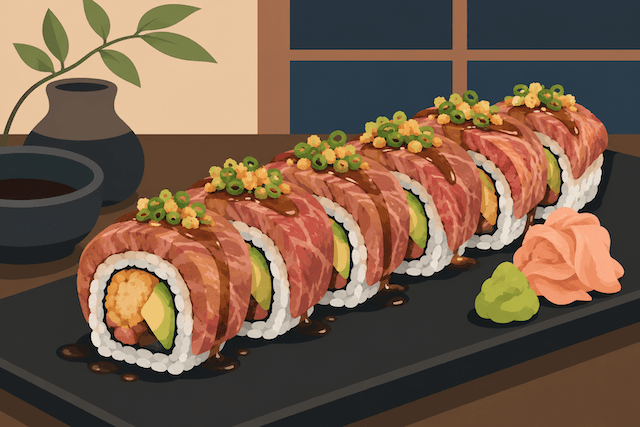
Wagyu beef sushi is a premium format that brings exceptional fat marbling, a buttery texture, and deep umami richness to Japanese-style preparations — characteristics that make it a natural pairing with seasoned sushi rice and bold finishing sauces like truffle mayo.
Key Takeaways
Wagyu beef is graded by marbling score — the higher the score, the more intramuscular fat and the more pronounced the melt-in-the-mouth texture.
The combination of wagyu tartare over sushi rice is a modern Japanese technique that blends Edomae rice craft with European-style raw beef preparation.
Truffle mayo functions as a bridge flavour in wagyu sushi dishes — it amplifies the fat content without overpowering the beef’s natural taste.
Wagyu cattle are generally associated with Beef Marbling Scores (BMS) significantly higher than standard USDA Prime grades, with Japanese A5 wagyu typically reaching the upper end of the scale.
The Wagyu Truffle Roll at Tokyo Sushi Speakeasy uses beef tartare mixed with chives, topped with wagyu slices, truffle mayo, and crispy garlic — confirm current ingredients and availability directly with the restaurant.
Wagyu in a sushi format requires precise temperature control and knife work — errors in either produce a dish that reads as heavy rather than refined.
What Makes Wagyu Beef Different From Standard Beef?
Wagyu refers to four Japanese cattle breeds — typically listed as Kuroge Washu, Akage Washu (Akaushi), Nihon Tankaku, and Mukaku Washu — bred selectively for intramuscular fat deposition. That fat, distributed as fine white threads throughout the muscle, is what produces the characteristic marbling wagyu is known for.
In standard beef, fat sits around the muscle rather than within it. In wagyu, the fat is inside the muscle fibres themselves. When eaten, particularly at room temperature or slightly warm, that intramuscular fat melts at a lower temperature than typical beef fat — which is why wagyu has a texture that registers as buttery rather than chewy.
Wagyu beef is generally associated with high Beef Marbling Scores, while USDA Prime — considered the top tier for standard American beef — is typically considered to correspond to a comparatively lower BMS range. Japanese A5 wagyu, the highest classification under Japan’s grading system, is commonly cited as requiring a BMS of 8 to 12 on the Japanese scale, though the full A5 designation also factors in yield and quality grades as assessed by the Japan Meat Grading Association.
That marbling difference is not cosmetic. It changes flavour compound distribution, texture, and how the beef interacts with other ingredients on the plate — which is exactly why wagyu and truffle mayo work so well together in a sushi context.
How Wagyu Tartare Over Sushi Rice Actually Works
The Role of the Rice
Edomae sushi rice is seasoned with rice vinegar, salt, and sugar to a precise balance — slightly acidic, lightly sweet, and warm enough to hold its shape without becoming dense. That acidity cuts through fat. Against the richness of wagyu tartare, it functions the way a squeeze of lemon functions against tuna: it brightens rather than competes.
In practice, the rice acts as the structural and flavour counterpoint. Without it, wagyu tartare alone reads as indulgent to the point of heaviness. With it, the dish has a beginning, middle, and finish.
What Tartare Preparation Does to Wagyu
Tartare-style preparation means finely hand-chopped raw beef, lightly seasoned and bound. It exposes more surface area than a sliced piece of beef would. For wagyu, this means the marbling fat becomes more evenly distributed through every bite, rather than concentrated in the visible white lines of a raw slice.
Chives, which appear in Tokyo Sushi Speakeasy’s Wagyu Truffle Roll, add a mild allium sharpness that keeps the fat from flattening the palate. It is a small addition that makes a measurable difference to how many pieces you can eat before the dish becomes fatiguing.
Where Truffle Mayo Fits
Truffle mayo is an emulsified sauce — oil and egg yolk as the base, truffle as the flavour agent. The oil content mirrors the fat already present in wagyu, so rather than contrasting the beef, truffle mayo amplifies it. What it contributes is the earthy, funky depth that truffle provides, layering an additional flavour register on top of the beef’s natural savouriness.
The key with truffle mayo in a wagyu dish is volume. Too much and the truffle overwhelms the beef. Applied as a finish — a line, a dot, or a thin drizzle — it frames the dish without taking it over.
The Wagyu Truffle Roll: How Tokyo Sushi Speakeasy Builds It
The Wagyu Truffle Roll is built in two distinct layers. The first is the roll itself — a structural base that carries the ingredients. The second is the topping, where the dish earns its character.
Beef tartare mixed with chives forms the primary topping, spread across the roll with enough coverage to register in every piece. Over that sits sliced wagyu — thin enough to take on the temperature of whatever it rests against, which means it begins to yield the moment it meets the warmth of the rice. Truffle mayo finishes the surface, and crispy garlic adds a textural contrast that prevents the dish from becoming uniformly soft.
The roll is typically cut into individual pieces, each one a self-contained unit of the full flavour architecture. That structure matters — it means the dish can be shared without losing cohesion, and it means the proportions of each ingredient hold from the first piece to the last. Confirm the current cut count with the restaurant directly.
It sits at the premium end of the signature roll menu — a price point that reflects both the cost of genuine wagyu and the labour involved in tartare preparation, which cannot be rushed or done ahead of service. Check the current menu for up-to-date pricing.
Why Wagyu Works in a Japanese Sushi Context
Historical Context
The use of beef in Japanese cuisine is more recent than many diners assume. Japan’s Meiji Restoration in the late 19th century is broadly associated with the beginning of wider beef consumption, following centuries during which Buddhist dietary practice had largely discouraged it — though historians note the transition was gradual rather than immediate. The integration of beef into Japanese cooking — eventually producing dishes like sukiyaki, shabu-shabu, and teppanyaki — took place over roughly 150 years.
In sushi specifically, beef has always been a modern addition rather than a traditional one. Edomae sushi, the style that underpins high-end Japanese restaurants in 2026, is built around fish and seafood. Wagyu in sushi represents a deliberate fusion — one that works because the flavour logic is sound, not because it follows historical precedent.
Umami Alignment
Both wagyu beef and sushi rice are high in umami compounds. Wagyu is rich in glutamates — the amino acids that produce the savoury, mouthcoating sensation associated with umami. Seasoned sushi rice contains vinegar-derived acidity that activates those glutamates. The result is a dish where the savoury register is considerably more intense than either ingredient would produce alone.
This is the same principle that makes soy sauce and tuna work together, or ponzu and sashimi. The combination of ingredients with complementary glutamate profiles produces a synergistic umami effect rather than simple addition.
What to Order Alongside Wagyu at Tokyo Sushi Speakeasy
Wagyu is a rich dish. The rest of the table should be structured to give it room.
Before the Wagyu Roll
Start with something clean and acidic. Sashimi — particularly yellowtail or snapper — calibrates the palate without loading it. A lighter white-fish cuts provide contrast against the heavier proteins that follow.
Tuna tataki, lightly seared and dressed with ponzu, also works well in this position. The sear adds a char note that makes the rawness of the wagyu tartare more pronounced by comparison.
Alongside the Wagyu Roll
The South Beach Roll — salmon, shrimp, and avocado topped with crispy crab and caviar — offers textural contrast without competing on richness. The crispy crab topping provides crunch that mirrors the crispy garlic on the wagyu roll without duplicating the flavour.
Avoid heavily sauced rolls at the same time as wagyu. Two sauce-forward dishes on the same pass will blur each other.
Drinks That Work With Wagyu
A junmai daiginjo sake — slightly fruity, clean, and lightly acidic — cuts through wagyu fat without stripping the flavour. Junmai styles, which use no added alcohol, tend to have a fuller body that stands up to the beef better than honjozo varieties.
For cocktails, something citrus-forward — like the Lychee Martini on the Tokyo Sushi Speakeasy menu — provides the same acid-fat contrast that sake does. Avoid anything sweet or cream-based alongside wagyu; the fat load becomes uncomfortable quickly.
Is Wagyu Beef Sushi Worth the Premium Price?
The premium on wagyu is real and well-documented. Japanese wagyu beef wholesale prices have consistently tracked at multiples of three to five times standard beef prices, depending on grade and cut. A5 wagyu from Japan, the grade most commonly referenced on high-end menus, carries significant import and handling costs before it reaches a kitchen.
What you are paying for, specifically, is the marbling — the intramuscular fat that cannot be replicated through feeding protocols alone and requires specific breed genetics to produce. That fat changes the eating experience in a way that is detectable, not theoretical.
In a sushi context, wagyu also requires skilled handling. The tartare must be chopped to the right consistency — too fine and it becomes paste, too coarse and the texture competes with the rice. The sliced wagyu on top must be cut thin enough to yield but not so thin that it tears. These are technique decisions that reflect the kitchen’s competence as much as the ingredient itself.
For a group sharing the full menu, the Wagyu Truffle Roll represents a low barrier to experiencing the combination when split between the table — check the current menu for pricing before you visit.
Frequently Asked Questions
What is wagyu beef and why is it considered premium?
Wagyu refers to four specific Japanese cattle breeds known for producing beef with exceptionally high intramuscular fat marbling. The Beef Marbling Score for genuine wagyu ranges from 4 to 12, compared to around 4 to 5 for USDA Prime beef. That marbling produces a texture that melts at body temperature and a flavour profile richer in glutamates than standard beef — which is why it commands a premium price in both retail and restaurant contexts.
Is wagyu in sushi served raw?
In tartare-style preparations like the Wagyu Truffle Roll, the beef component is served raw. Raw wagyu at this level of quality — sourced, handled, and kept at strict temperature through service — carries the same food-safety logic as high-grade sashimi: freshness, cold chain integrity, and sourcing from a traceable supplier are what make it safe to eat. The sliced wagyu topping is also typically served without heat applied.
What does truffle mayo taste like with wagyu?
Truffle mayo is earthy, savoury, and rich — with the characteristic fungal depth that black or white truffle brings to any emulsified sauce. Against wagyu, it amplifies the beef’s own richness and adds an aromatic complexity that plain mayo would not. The combination reads as luxurious rather than heavy when the sauce is applied in proportion.
How does the Wagyu Truffle Roll differ from a standard sushi roll?
Standard sushi rolls use fish or seafood as the primary protein. The Wagyu Truffle Roll uses beef tartare and sliced wagyu, placing it in a different flavour register entirely — more umami-forward, richer in fat, and finished with ingredients (truffle mayo, crispy garlic) that are not typical of traditional Japanese sushi. It is a modern fusion construction built on Edomae rice technique.
Can I pair sake with wagyu sushi?
Yes, and junmai daiginjo is the most effective pairing. Its clean acidity and light fruitiness cut through wagyu fat without competing with the truffle mayo. If sake is unfamiliar territory, the beginners’ guide to sake on the Tokyo Sushi Speakeasy blog covers the main styles and what to expect from each.
Is the Wagyu Truffle Roll suitable for sharing?
The roll is cut into individual pieces, making it straightforward to share between two to four people as part of a wider table order. It works best as one dish among several rather than the sole focus of a meal — the richness is better appreciated when the table has lighter options alongside it.
The Wagyu Truffle Roll at Tokyo Sushi Speakeasy is one of the clearest examples on the South Beach dining scene of premium ingredients handled with genuine technique. If you are planning a table and want one dish that demonstrates what modern Japanese cooking can do with beef, this is where to start.
Reserve your table at Tokyo Sushi Speakeasy and explore the full signature menu before you arrive.